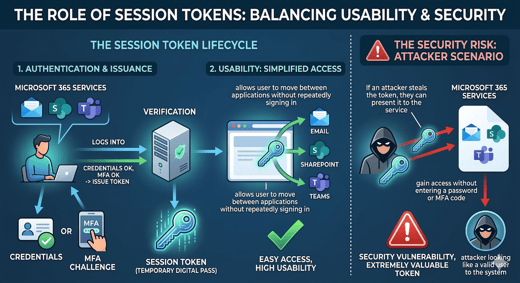

Full cloud adoption doesn’t just change where your systems and data live. It changes how security works.
When organizations move to a fully native-cloud environment with no servers, security doesn’t disappear — it shifts. Instead of protecting the infrastructure inside the building, security becomes dependent on three critical domains:
- The devices people use
- The networks they connect through
- The cloud platforms that now store the company’s data.
Understanding these three areas is essential to operating securely in a modern environment.
In traditional environments, security revolved around on-premise servers and Active Directory running inside the corporate network. User identities, group memberships, file shares, applications, and permissions were all tied together inside the domain, sitting on infrastructure you physically owned and maintained.
As long as computers and users were authenticated to Active Directory and the firewall protected the network edge, the assumption was that everything inside that environment could generally be trusted.
Over time, many organizations adopted a hybrid model. Email, collaboration, and document storage moved to platforms like Microsoft 365, while core systems — identity, device management and line-of-business applications continued running on traditional servers. Even today, many businesses still operate this way, while others are working to fully leverage native cloud platforms and eliminate servers.
When using a fully cloud-native design, the model changes.
Security responsibility shifts across three equally critical domains:
- Endpoint security (protecting computers and devices)
- Network security & resilience (protecting connectivity from threats and downtime)
- Cloud configuration management (protecting identities, access, and data)
Here’s the key thing most leadership teams miss:
Infrastructure becomes simpler.
Security becomes more distributed.
You may have no servers.
But you absolutely do not have less risk.
As organizations reduce physical infrastructure, identity and device management move to the forefront. Gartner projects worldwide public cloud spending will reach $679 billion in 2024, and a significant portion of that investment is driven by security.
For executives planning full cloud adoption, this shift isn’t just technical. It affects budgeting, governance and your organization’s risk profile.
The Three-Domain Security Framework
Security no longer revolves around a server room. It operates across three interconnected domains. And each one demands a unique type of attention.
Unlike traditional server-centric models, security is now distributed and layered.
Let’s break that down.
1. Endpoint Domain: Where Risk Now Begins
In a native-cloud environment, endpoints (computers and mobile devices) become a critical attack surface.
Every laptop.
Every mobile device.
Every remote workstation.
Each device accessing platforms like Microsoft 365, QuickBooks Online, or other SaaS applications becomes a potential entry point into the business. In a native-cloud environment, endpoints are no longer just workstations — they are the front door to your company’s data.
Protecting these devices becomes foundational.
That means implementing several layers of control to ensure that every device accessing company resources is secure, compliant, and continuously monitored:
- Centralized device management – Security settings, device health, encryption, and compliance policies are enforced through platforms such as Microsoft Intune and Microsoft Entra, ensuring only trusted, healthy devices can access company resources.
- Identity-backed authentication – Multi-factor authentication is enforced and tied to both user identity and device trust, verifying not only who is signing in but also whether the device itself is known, approved, and meets security standards.
- Behavioural analytics – Modern identity platforms analyze sign-in patterns and user behaviour to detect anomalies, helping identify suspicious activity when users interact with cloud services.
- Endpoint Detection & Response (EDR/MDR) – Advanced endpoint protection actively monitors devices for ransomware, malware, and other threats, enabling rapid detection and response before damage spreads.
- Mobile Device Management (MDM) – Smartphones and tablets accessing corporate data are governed by security policies, ensuring company information remains protected even on mobile devices.
- Managed software updates – Operating systems and applications are kept up to date automatically to close vulnerabilities that attackers frequently exploit.
- User security training – Ongoing training helps employees recognize phishing, social engineering, credential theft, and other modern attack methods. This often includes simulated phishing campaigns, security awareness training, and practical guidance on safely using cloud applications.
In a native-cloud model, the security of each endpoint — and the people using them — directly impacts the security of the entire organization.
Here’s the uncomfortable truth: If a compromised device or user is trusted, your cloud is exposed.
As Kris Wilkinson, CEO at Sirkit, puts it:
“The future of IT infrastructure is dramatically simpler than what businesses have managed for the past twenty years. Servers will continue to disappear as organizations adopt native cloud platforms. But as infrastructure disappears, security doesn’t. It shifts. One thing leaders must understand: security is not built into the cloud by default — and it should never be assumed.”
That dependency starts at the device level. And if you’ve migrated to Microsoft 365 but haven’t implemented device compliance and conditional access policies, you still have risks to mitigate.
2. Network Domain: The Bridge to Everything
In cloud environments, the network is no longer a perimeter. It’s a bridge.
Security shifts away from protecting a physical boundary toward securing the connections that link users, devices, and cloud services.
Your workforce now depends on internet connectivity for nearly every core business function. Email, collaboration, accounting systems, document management, and line-of-business platforms all rely on stable, secure access to the cloud.
That means your network is no longer just infrastructure — it is a business continuity dependency. Protecting connectivity becomes critical.
Key elements of modern network security include:
- Zero-Trust Network Access (ZTNA) is replacing traditional VPN models
- Encrypted communications for all connections to cloud platforms
- Next-generation firewall protection at permanent physical locations, including IPS, Advanced Threat Protection, Web Filtering, and Application Control
- Network segmentation to isolate work devices from higher-risk systems such as surveillance networks or IoT devices
- Real-time monitoring and threat detection across network traffic
- Redundant internet connections with independent paths to prevent downtime
- Secure remote connectivity practices, including using mobile hotspotting instead of untrusted public networks when traveling
In a native-cloud environment, connectivity becomes both the lifeline of the business and a critical security path.
How users and devices reach the cloud matters just as much as what happens once they get there.
3. Cloud Domain: Configuration Is Everything
This is where the biggest misconception lives. Many organizations assume that once they move to the cloud, security is handled.
It isn’t.
Cloud providers secure their infrastructure. You remain responsible for your data, users, access, and configurations. This is known as the shared responsibility model, and misunderstanding it is one of the most common causes of cloud security failures.
In native-cloud environments, security depends on disciplined configuration, continuous monitoring, and layered controls. It also requires staying current with evolving best practices as cloud platforms continue to introduce new capabilities.
That means implementing controls such as:
- Role-based identity and access management to ensure users only access what they need
- Regular configuration audits to detect drift from security best practices
- Real-time monitoring and automated response to suspicious activity
- Cloud-to-cloud backups to protect data from deletion, corruption, or ransomware
- Ongoing compliance monitoring to ensure policies remain enforced
The risk of getting this wrong is significant.
According to IBM’s Cost of a Data Breach Report, the average cloud breach now costs $4.75 million per incident, with misconfiguration among the leading causes.
Misconfiguration.
Not sophisticated nation-state attacks.
Just configuration errors.
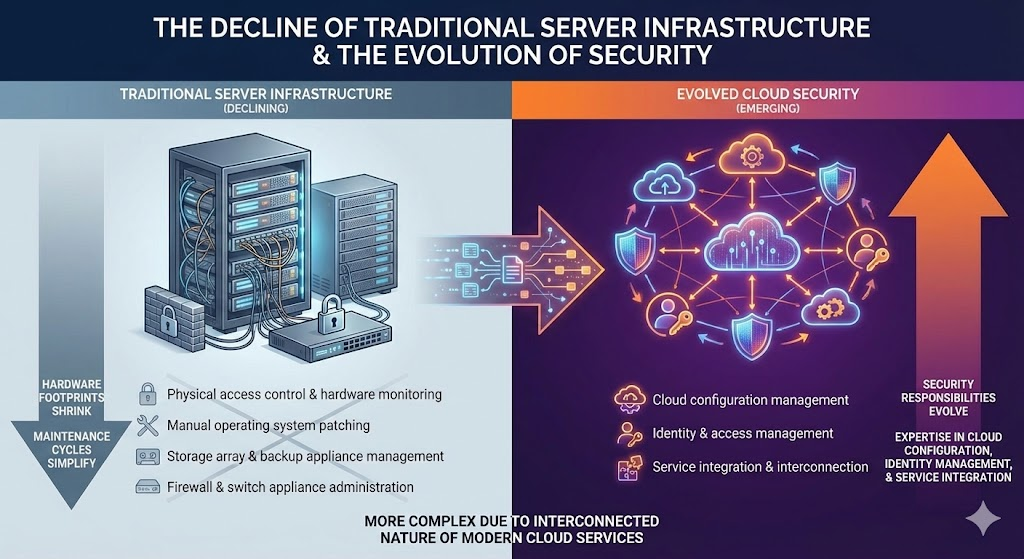
The Decline of Traditional Server Infrastructure
Yes, traditional server infrastructure is declining. Physical hardware footprints are shrinking, and many of the maintenance tasks businesses once depended on are fading away.
But security responsibility does not disappear.
It shifts.
Many of the operational tasks that defined traditional IT environments are becoming less central, including:
- Physical access controls to server rooms and equipment
- Manual operating system patching and server maintenance
- Backup appliance management
As organizations adopt native-cloud platforms, these responsibilities give way to a new set of priorities.
Organizations must now develop expertise in:
- Cloud configuration and governance
- Identity and access management
- Secure service integration across cloud platforms
- Access policy design and enforcement
In many cases, this becomes more complex than traditional server management, because modern cloud services are deeply interconnected.
A configuration change in one system can impact security across the entire environment.
Infrastructure becomes simpler.
Governance becomes more critical.
And organizations that recognize this shift early will be far better positioned to operate securely in a cloud-first world.
Identity Becomes the New Perimeter
“In today’s cloud-first world, your identity is your new perimeter,” Kris explains.
As organizations move deeper into SaaS and native cloud platforms, authentication and device trust become the gatekeepers of company data. Identity governance sits at the center of the three domains we’ve discussed — endpoints, networks, and cloud configuration.
If identity controls are weak, those other protections lose their effectiveness.
That’s why executive awareness matters. Moving systems to the cloud does not, by default, reduce risk. It simply shifts where that risk must be managed.
Budgeting for the Shift
Cloud adoption doesn’t eliminate the need for security investment.
It reallocates it.
Instead of spending primarily on hardware and infrastructure refresh cycles, organizations increasingly invest in:
- Cloud security licensing and identity protection
- User training and security awareness
- Monitoring, analytics, and incident response capabilities
Security becomes less capital-heavy and far more continuous.
Organizations that recognize this shift early often find they don’t just maintain their security posture — they strengthen it.
Because while infrastructure becomes simpler in a native-cloud world, the responsibility to secure it becomes more intentional than ever.