
Cyber insurance can help absorb the financial impact of a cyber incident, but it’s conditional. What gets paid depends on how the policy defines a covered event, which security controls were in place, and whether the incident unfolded the way the insurer expects.
In real claims, coverage rarely fails because a business “did the wrong thing.” It fails because definitions, controls, timelines, or legal constraints didn’t line up with what was represented during underwriting.
One of the biggest pitfalls is the insurance application itself.
In practice, accidentally misrepresenting your environment is treated the same as intentionally misrepresenting it. For example, a checkbox like ‘Are all systems protected by MFA?’ is almost never literally true—printers, legacy tools, or niche apps may not support MFA. A more accurate answer is: ‘All systems that support MFA have MFA configured. System XYZ does not support MFA.
It’s also important to understand that even when coverage applies, businesses often have to front many of the costs themselves. Ransomware response, forensic work, legal support, and restoration expenses are frequently paid out of pocket first, with reimbursement only coming later once the claim is reviewed and the insurer confirms there was no policy breach.
This guide breaks down what cyber insurance typically covers, where claims most often break down, and how to size coverage realistically based on how incidents actually play out.
How Cyber Insurance Coverage Is Structured
Most cyber policies are built around two core categories:
- First-party coverage – your direct costs to respond and recover
- Third-party coverage – claims, lawsuits, and regulatory exposure brought by others
Reading a policy through this lens makes it much easier to understand what’s included, what’s limited, and what insurers expect before paying.
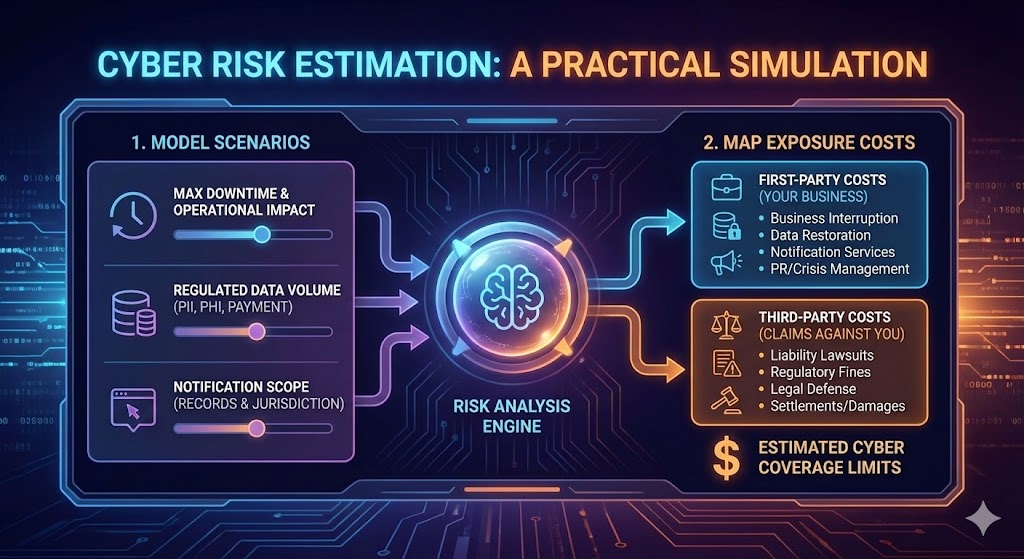
First-Party Coverage (Costs Your Business Pays Directly)
First-party coverage applies when your organization is the victim of a cyber incident. This portion of the policy is designed to help you regain control, restore operations, and manage the immediate impact.
Common first-party coverages include:
- Digital forensics to determine what happened, how access was gained, and what data was affected
- Incident response and breach coordination, often through an insurer-appointed breach coach
- Ransomware response costs, which may include specialist support and negotiation services, depending on policy terms
- Data and system restoration to rebuild systems and recover lost or encrypted data
- Breach notification services, including mailing, email notices, and call-centre support
- Credit or identity monitoring, when required by law or approved by the insurer
- Public relations and reputation management, included in some policies
- Business interruption coverage for lost income and extra expenses resulting from a covered cyber event
Coverage applies only if the incident meets the policy’s definition of a covered event and the required security controls were in place at the time of loss.
Third-Party Coverage (Claims Made Against Your Business)
Third-party coverage addresses situations where customers, partners, or regulators allege that your organization failed to protect data or systems.
Common third-party coverages include:
- Defense costs for lawsuits tied to privacy or security incidents
- Damages or settlements, where legally insurable and covered
- Regulatory defense costs and certain proceedings
- Contractual liability, when specifically included
- Media liability, such as claims related to content or publishing, in some forms
Real-World Incidents Cyber Insurance Can Cover
When ransomware hits
Many policies cover ransomware-related response costs and may cover extortion payments if they are legal, approved, and within policy limits.
Coverage often hinges on:
- Whether the event meets the policy’s definition of extortion
- Whether required controls were accurately represented during underwriting
- Whether the insurer’s response workflow is followed
There is an additional layer many businesses don’t anticipate. Governments have implemented digital sanctions that prohibit payments to certain ransomware groups because those funds may support terrorism or sanctioned entities. In those cases, even if a policy technically includes extortion coverage, the business may not be legally allowed to pay the ransom at all. This restriction doesn’t apply to every incident, but when it does, it can fundamentally change the response options available.
When money is sent to the wrong place (Business Email Compromise)
BEC is frequently misunderstood because cyber and crime coverage can overlap.
Policies may cover:
- Fraudulent wire transfers under a crime or social-engineering endorsement
- Investigation and remediation following account takeover
- Legal and recovery efforts
Stolen funds are often not covered unless the endorsement precisely matches how the fraud occurred.
When personal data is exposed
For privacy breaches, cyber insurance commonly covers response logistics and liability.
Typical covered costs include:
- Forensic scoping of affected records
- Notification letters and distribution
- Call-centre and identity-protection services
- Defense costs for privacy-related claims
When systems go dark
Business interruption coverage may apply when a cyber event prevents normal operations.
Coverage usually focuses on:
- Loss of income during the interruption period
- Extra expense to continue operating
- Waiting periods, minimum downtime thresholds, and documentation requirements
What’s Often Excluded or Limited (The “Why Didn’t This Get Paid?” List)
Exclusions vary by carrier, but the same friction points show up repeatedly during claims.
Common exclusions or limits include:
- Known issues or prior incidents that began before the policy period
- Failure to maintain required controls stated in underwriting (MFA, backups, logging, patching cadence)
- Unpatched or end-of-life systems, especially if tied to misrepresentation
- War and state-sponsored attack exclusions, depending on wording and jurisdiction
- Bodily injury and property damage, unless endorsed
- Contract penalties and certain consequential damages, unless explicitly covered
- Betterment costs, meaning upgrades beyond restoring the prior state
- Reputational loss, market share loss, and future profits outside defined business interruption terms
And it’s not just whether the control caused the incident. If the insurer finds an undisclosed exception (like a single app that doesn’t support MFA), even if it’s unrelated to the claim, they may argue the application was falsified and deny coverage.
When coverage fails, it’s usually because the environment, documentation, policy language, or legal constraints didn’t align.
How to Estimate the Coverage You Need (A Practical Approach)
A practical way to size coverage is to model your credible worst day, then map costs to first-party and third-party exposure.
Start by:
- Identifying maximum tolerable downtime and daily operational impact
- Inventorying regulated data types (PII, PHI, payment data)
- Estimating notification scope by record count and jurisdiction
- Calculating restoration costs across systems, SaaS platforms, and endpoints
- Adding professional fees for legal, forensic, and incident-response support
- Assessing whether third-party claims are realistic based on contracts and customers
A 30-person organization and a 1,000-person organization can both benefit from cyber insurance, but the cost drivers differ.
Smaller organizations often feel the operational shock more. A single incident can stall billing, payroll, and delivery almost immediately, making downtime the biggest risk.
Larger organizations typically face higher data volume and complexity, which increases notification costs, legal coordination, and third-party exposure.
A Practical Takeaway
Cyber insurance works best when it mirrors reality. If your technical environment, your written security program, your policy definitions, and the legal framework governing payments don’t match, claims friction is almost guaranteed.
That includes being precise in the application, including documenting exceptions is often safer than overstating controls.
FAQs
Does cyber insurance cover ransomware payments?
It may, if extortion is covered, the payment is legal, and the insurer’s approval process is followed.
Does cyber insurance cover Microsoft 365 email compromise?
Incident response and remediation are often covered. Stolen funds usually require a social-engineering or crime endorsement.
Will cyber insurance cover regulatory fines?
Some policies cover regulatory defense costs. Fines and penalties may be limited or excluded depending on jurisdiction.
Does cyber insurance require an MFA?
Many insurers expect MFA, especially for remote access and privileged accounts, and may tie coverage to maintaining it.
What is dependent business interruption coverage?
It covers downtime caused by a cyber event at a third-party provider you rely on, subject to definitions and sublimits.